Primordial Matrix
PL-158HardFluids & particlesWebGL shaders
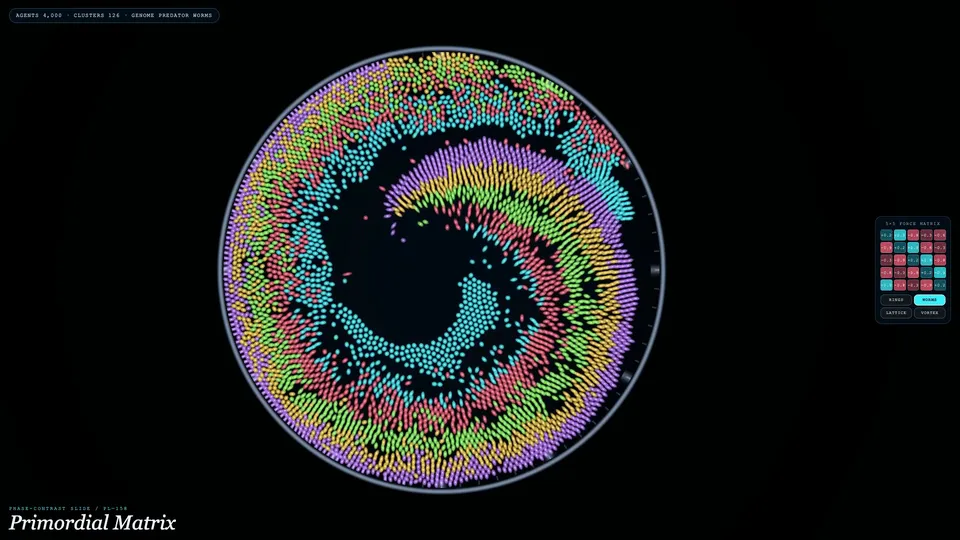
A microscope view of 4,000 particle-life organisms in raw WebGL2: spatial-grid physics, a force matrix, chase versus crystal behavior and zoom.
Download fileMade for ChatGPT, Claude, Gemini, Grok and other AI tools
How to run
- Download the file or copy the prompt.
- Upload or paste it into any AI chat or coding tool, and send.
- Save the HTML it gives you as a file and open it in Chrome.
- Open it with ?test=1 and look in the browser console for the TEST lines.
What it tests
A microscope view of 4,000 particle-life organisms in raw WebGL2: spatial-grid physics, a force matrix, chase versus crystal behavior and zoom.
The checks
- Scale & framing: agents === 4000, the microscope slide fills at least 70% of the screen height, and zero external network files are requested (
performance.getEntriesByType("resource").length === 0). - Steric repulsion (no point collapse): after 5 s of simulation under maximum +1.0 self-attraction, fewer than 2% of sampled neighbor pairs sit closer than
0.35 * r_min, and all 4,000 agents remain inside the slide radius. - Asymmetric chase vs symmetric crystal: under an antisymmetric predator matrix (
M[0][1] = +0.9, M[1][0] = -0.9), meanSpeed after 4 s is at least 2.2x higher than under a symmetric crystal matrix (M[a][b] = M[b][a]). - Live genome & pipette response: switching presets increments mutations by 1 and measurably changes
clustersby >= 20% within 3 s; dropping a nutrient pulse increments nutrientDrops by 1 and draws nearby organisms inward. - Smooth 4,000-agent runtime: 28 s of hands-free advance() visits >= 3 genomes with mutations >= 2, nutrientDrops >= 1, and zero console errors.
Runs by model
- Gemini 4 Carbon Mediumvia Devin Desktop chat2026-11-19First tryAgent checkPass60 fps
Show the full prompt
PRIMORDIAL MATRIX: 4,000-Agent Particle Life Microscope
HOOK OBJECT: window.__primordial

Build "PRIMORDIAL MATRIX": a dark-field phase-contrast microscope world in raw WebGL2 and GLSL (no Three.js, no libraries) where 4,000 glowing micro-organisms across 5 species self-organize into hunting worms, rotating cell membranes, pulsing crystals and symbiotic flocks driven purely by a live 5x5 signed attraction/repulsion matrix.

LOOK
- Style: dark-field bioluminescent wet-slide microscopy, palette deep abyss slide #03070E, brass reticle #8E9BAE, cyan #3CF2FF, coral #FF5D73, lime #8BFF5A, amber #FFC847, violet #B975FF.
- Subject: a circular dark-field microscope aperture with fine degree/micrometer ticks filling at least 75% of the screen height, containing 4,000 soft-haloed motile organisms with faint phosphor motion trails and refractive membrane glow when neighbors cluster, flanked on wide screens (or tucked cleanly below on portrait phones) by a crisp 5x5 color-coded interaction matrix widget that never overlaps the circular slide.
- FIRST FRAME (t = 0, no input): all 4,000 glowing organisms distributed in seeded cellular rings inside the lit microscope ring, filling 75%+ of the screen height, bright and immediately readable on frame 0.

MOTION / PLAY
- Controls: click/tap any cell of the 5x5 matrix widget to cycle/nudge species attraction (-1.0 to +1.0), click/drag inside the slide to drop nutrient attractors or stir a pipette vortex, wheel/pinch or `setCamera(panX, panY, zoom)` to zoom right into individual hunting chains (up to 3.5x) and pan smoothly, keys 1–4 or preset buttons to morph the genome between 4 named canonical ecosystems (SYMBIONT RINGS, PREDATOR WORMS, MITOSIS LATTICE, VORTEX CORAL).
- Spatial-grid physics: uniform spatial hash grid (no O(N^2) freeze!) so all 4,000 agents step smoothly at 60 fps. Every pair within interaction radius R obeys a bistable kernel: strong steric repulsion below `r_min` (preventing point collapse) and signed linear-tent attraction/repulsion from `matrix[a][b]` between `r_min` and `R`, confined softly inside the circular slide wall.
- ATTRACT MODE: with no input, a hands-free lab study runs on load and loops every 28–30 s, cycling cleanly through at least 3 canonical genomes, zooming in briefly on an emergent multi-species structure and back out, and dropping a nutrient pulse. Any input takes over; the demo resumes after 8 s with no input.

SOUND
- Genome mutation / preset switch -> crystalline harmonic chord whose intervals reflect the matrix symmetry.
- Pipette stir or nutrient drop -> wet microscopic droplet blip and gentle fluid swish.
- Ambient bio-activity -> subtle generative glass-marimba pulses driven by real cluster density and chase speed.

COUNTERS
stats() returns { fps, agents, clusters, mutations, nutrientDrops, meanSpeed }.
- agents: exact active organism count (4,000).
- clusters: live count of occupied high-density spatial cells (>= 14 organisms in a cell), reflecting real self-assembly.
- mutations: +1 each time the 5x5 genome preset or matrix cell changes after load. Never on load.
- nutrientDrops: +1 each time a nutrient pulse is dropped onto the slide.
- On screen: clean lab readout outside the circular aperture showing "AGENTS 4,000 · CLUSTERS NN · GENOME <NAME>", never overlapping the slide.

CHECKS for ?test=1
With ?test=1, run an accelerated self-test that measures real positions and real events (not self-set flags) and logs "TEST n PASS" or "TEST n FAIL: reason" to the console and to window.__testResults:
1. Scale & framing: agents === 4000, the microscope slide fills at least 70% of the screen height, and zero external network files are requested (`performance.getEntriesByType("resource").length === 0`).
2. Steric repulsion (no point collapse): after 5 s of simulation under maximum +1.0 self-attraction, fewer than 2% of sampled neighbor pairs sit closer than `0.35 * r_min`, and all 4,000 agents remain inside the slide radius.
3. Asymmetric chase vs symmetric crystal: under an antisymmetric predator matrix (`M[0][1] = +0.9, M[1][0] = -0.9`), meanSpeed after 4 s is at least 2.2x higher than under a symmetric crystal matrix (`M[a][b] = M[b][a]`).
4. Live genome & pipette response: switching presets increments mutations by 1 and measurably changes `clusters` by >= 20% within 3 s; dropping a nutrient pulse increments nutrientDrops by 1 and draws nearby organisms inward.
5. Smooth 4,000-agent runtime: 28 s of hands-free advance() visits >= 3 genomes with mutations >= 2, nutrientDrops >= 1, and zero console errors.

KEEP IT SHORT
- Keep the whole file under about 1,500 lines (soft target) so you can write it in one pass and finish well inside 15 minutes.
- Save lines with helpers, loops and instancing, not by dropping features. Everything above must really work: no placeholders, no TODOs.

BUILD RULES (all required):
- Deliver ONE self-contained HTML file: inline CSS and JS, no build step, no local assets. Libraries only from a CDN. If you use Three.js, use exactly this import map: {"imports":{"three":"https://cdn.jsdelivr.net/npm/three@0.160.0/build/three.module.js","three/addons/":"https://cdn.jsdelivr.net/npm/three@0.160.0/examples/jsm/"}}
- It must open straight from disk in desktop Chrome and on an iPhone (Safari), fill the full screen, handle resize and touch, and stay smooth (target 60 fps).
- It must look stunning in the very FIRST frame: no black screen, no loading wait, no tiny subject. The main subject fills at least 50% of the screen height.
- SOUND (required): all sound is made in code with Web Audio (no audio files). Show a small "🔊 TAP FOR SOUND" chip; on the first tap create ONE AudioContext, route everything through a master gain of 0.6 into a DynamicsCompressor, and hide the chip. Also expose enableAudio() on the hook object named at the top.
- Expose the hook object named at the top with: setCameraOrbit(azimuthDeg, elevationDeg, distance) (or an equivalent camera setter), advance(seconds) that steps the simulation exactly that much for still captures, enableAudio(), and stats() returning {fps, ...the counters named above}. Use a fixed random seed of 360 so every run is the same.
- Every on-screen counter must count a real event you can see happen. No fake numbers.
- No text overlapping the subject; any label must be readable in a paused frame.
- No brand logos, no real people, no copyrighted characters, brand names or logos.

FAILURE MODES TO AVOID
- Naive O(N^2) loop over 4,000 particles in JavaScript that tanks frame rate below 20 fps.
- Missing short-range repulsion so all particles collapse into 5 static dots.
- Additive-blending whiteout where dense clusters blow out into featureless white blobs.
- Matrix UI covering the microscope aperture on desktop or 390x844 portrait screens.
- Particles escaping off screen instead of staying inside the circular microscope dish.
- The same variable declared twice, or methods called on objects that don't exist yet.

SELF-TEST LOOP
- If you can run code: build the file, open it, read the console, run ?test=1, and take screenshots at 3 s, 10 s and 30 s at 1280x720 and 390x844. Look at the screenshots and fix what looks wrong. Fix and retest until all 5 checks pass with zero console errors. Mark anything you could not run as UNMEASURED; never invent results.
- If you are chat-only: go through this prompt line by line, check your code against each line, and fix anything that would fail. Then write one corrected, complete file.
- Final answer: ONE complete HTML file in ONE code block, then the 5 checks marked PASS, FAIL or UNMEASURED. No snippets, no "rest unchanged".
Built one? Post it on X and tag @wikiwaynePost on X