Glassblower's Kiln
PL-156HardFluids & particlesThree.js
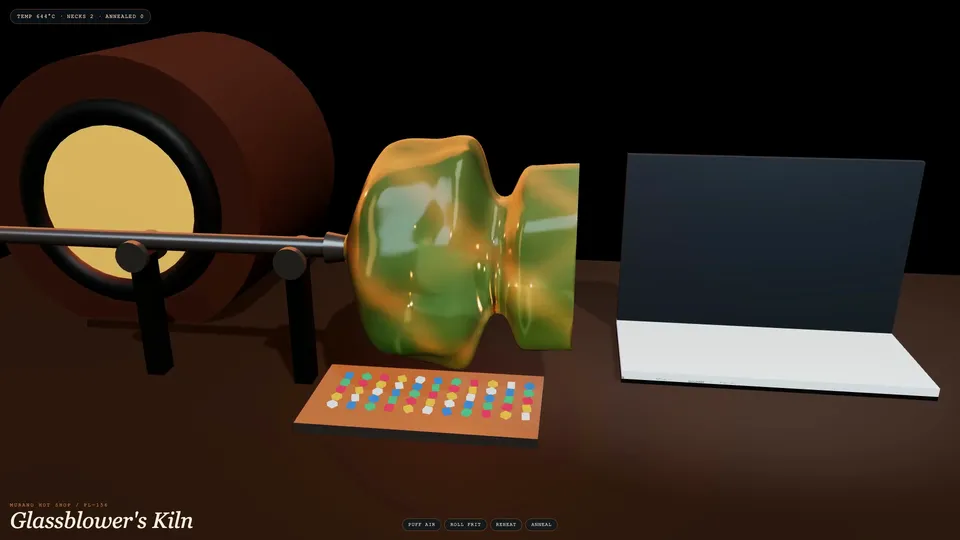
Shaping hot glass at a workbench: real-time lathe sculpting with volume conservation, heat stiffening, glow-to-glass shading and a shelf of finished vessels.
Download fileMade for ChatGPT, Claude, Gemini, Grok and other AI tools
How to run
- Download the file or copy the prompt.
- Upload or paste it into any AI chat or coding tool, and send.
- Save the HTML it gives you as a file and open it in Chrome.
- Open it with ?test=1 and look in the browser console for the TEST lines.
What it tests
Shaping hot glass at a workbench: real-time lathe sculpting with volume conservation, heat stiffening, glow-to-glass shading and a shelf of finished vessels.
The checks
- First frame: the blowpipe parison and workbench span at least 50% of the screen height, tempC starts above 950°C, and the parison spins continuously.
- Thermal stiffening: puffing for 1.5 s at >950°C expands maximum vessel radius by at least 35%, whereas puffing for 1.5 s when cooled below 550°C changes radius by less than 3%.
- Jack sculpting: pressing the jacks at the mid-section narrows that ring by at least 18%, nudges neighboring rings outward, and increments neckings by exactly 1.
- Cooling & color transition: as tempC drops from 1,050°C to 250°C, emissive orange intensity falls by over 85% while jewel-glass transmission color remains clearly visible on the annealer shelf.
- Attract cycle: advancing 28 s hands-free completes at least 1 sculpted vessel with neckings >= 1 and vesselsAnnealed >= 1, places the cooled vessel on the shelf, starts a new gather in a different jewel color, and logs zero console errors.
Runs by model
- Gemini 4 Carbon Mediumvia Devin Desktop chat2026-11-19First tryAgent checkPass60 fps
Show the full prompt
GLASSBLOWER'S KILN: Gather, Breath, Jack & Anneal
HOOK OBJECT: window.__kiln

Build "GLASSBLOWER'S KILN": an artisan hot-shop workbench in Three.js where a glowing 1,100°C gather of molten glass spins on a steel blowpipe in front of a roaring brick glory-hole furnace. Puffing air inflates the hollow parison, pressing wooden jacks carves smooth necks and shoulders while hot zones glow bright orange, rolling over frit adds spiral color canes, and finished vessels cool on an annealer shelf into translucent jewel-toned crystal.

LOOK
- Style: warm Venetian night glasshouse, palette furnace brick #26140E, molten core #FF5A14, cherry heat #FF9E3D, cooled cobalt #2C7BE5, emerald #23B574, ruby #D9385A, steel #9BA3AE.
- Subject: a spinning steel blowpipe on iron roller stands holding a 64-ring axisymmetric lathe vessel (outer + inner wall look via physical transmission, clearcoat and per-vertex blackbody emissive glow driven by real ring temperature from 1,100°C down to 180°C), a glowing arched glory-hole furnace at the left back, movable wooden jack blades, a marver frit tray, and a lit annealer shelf on the right holding up to 4 finished vessels.
- FIRST FRAME (t = 0, no input): close workbench view with the glowing orange parison on the spinning pipe and furnace mouth filling at least 55% of the screen height, heat shimmer and warm shadows visible, HUD neatly in the top-left corner away from the glass.

MOTION / PLAY
- Controls: hold Space or the PUFF button to blow air (inflating hotter rings faster than cooler rings); drag directly on the spinning parison with mouse or touch to press the wooden jacks inward and sculpt a neck, waist or flared lip while adjacent rings bulge slightly to conserve glass volume; press R or REHEAT to slide toward the glory hole and raise temperature back above 1,000°C; press F or FRIT to roll spiral colored canes onto the surface; press A or ANNEAL to tap the finished vessel onto the shelf and gather a fresh molten blob.
- Cooling physics: glass temperature cools steadily in open air (~45°C/s) and stiffens below 650°C so cold rings resist puffing and jacking until reheated.
- ATTRACT MODE: with no input, a hands-free master-artisan demo starts on load and loops every 25–30 s, sculpting a complete vessel from molten gather (puffing, jacking a waist and flared rim, rolling frit canes, and annealing it onto the shelf where it cools into clear colored crystal) before starting the next design. Any input takes over; the demo resumes after 8 s with no input.

SOUND
- Furnace draft -> warm low roaring rumble that swells during REHEAT.
- Puffing air -> airy breath whoosh pitched downward as internal volume expands.
- Wooden jacks touching hot spinning glass -> sizzling wood-on-glass friction hiss.
- Tap-off to annealer shelf -> bright crystalline glass ping chime.

COUNTERS
stats() returns { fps, tempC, volumeCm3, neckings, fritCoats, vesselsAnnealed }.
- tempC: live average temperature of the active parison in °C.
- neckings: +1 when jack pressure visibly narrows any ring radius by at least 18% from its prior radius (once per pinch gesture). Never on a timer, never on load.
- fritCoats: +1 when colored cane stripes are rolled onto the active gather.
- vesselsAnnealed: +1 only when a sculpted vessel is tapped off onto the annealer shelf and visibly appears in the rack.
- On screen: top-left panel "TEMP NNN°C · NECKS N · ANNEALED N", readable in a paused frame and never over the parison.

CHECKS for ?test=1
With ?test=1, run an accelerated self-test that measures real positions and real events (not self-set flags) and logs "TEST n PASS" or "TEST n FAIL: reason" to the console and to window.__testResults:
1. First frame: the blowpipe parison and workbench span at least 50% of the screen height, tempC starts above 950°C, and the parison spins continuously.
2. Thermal stiffening: puffing for 1.5 s at >950°C expands maximum vessel radius by at least 35%, whereas puffing for 1.5 s when cooled below 550°C changes radius by less than 3%.
3. Jack sculpting: pressing the jacks at the mid-section narrows that ring by at least 18%, nudges neighboring rings outward, and increments neckings by exactly 1.
4. Cooling & color transition: as tempC drops from 1,050°C to 250°C, emissive orange intensity falls by over 85% while jewel-glass transmission color remains clearly visible on the annealer shelf.
5. Attract cycle: advancing 28 s hands-free completes at least 1 sculpted vessel with neckings >= 1 and vesselsAnnealed >= 1, places the cooled vessel on the shelf, starts a new gather in a different jewel color, and logs zero console errors.

KEEP IT SHORT
- Keep the whole file under about 1,500 lines (soft target) so you can write it in one pass and finish well inside 15 minutes.
- Save lines with helpers, loops and instancing, not by dropping features. Everything above must really work: no placeholders, no TODOs.

BUILD RULES (all required):
- Deliver ONE self-contained HTML file: inline CSS and JS, no build step, no local assets. Libraries only from a CDN. If you use Three.js, use exactly this import map: {"imports":{"three":"https://cdn.jsdelivr.net/npm/three@0.160.0/build/three.module.js","three/addons/":"https://cdn.jsdelivr.net/npm/three@0.160.0/examples/jsm/"}}
- It must open straight from disk in desktop Chrome and on an iPhone (Safari), fill the full screen, handle resize and touch, and stay smooth (target 60 fps).
- It must look stunning in the very FIRST frame: no black screen, no loading wait, no tiny subject. The main subject fills at least 50% of the screen height.
- SOUND (required): all sound is made in code with Web Audio (no audio files). Show a small "🔊 TAP FOR SOUND" chip; on the first tap create ONE AudioContext, route everything through a master gain of 0.6 into a DynamicsCompressor, and hide the chip. Also expose enableAudio() on the hook object named at the top.
- Expose the hook object named at the top with: setCameraOrbit(azimuthDeg, elevationDeg, distance) (or an equivalent camera setter), advance(seconds) that steps the simulation exactly that much for still captures, enableAudio(), and stats() returning {fps, ...the counters named above}. Use a fixed random seed of 360 so every run is the same.
- Every on-screen counter must count a real event you can see happen. No fake numbers.
- No text overlapping the subject; any label must be readable in a paused frame.
- No brand logos, no real people, no copyrighted characters, brand names or logos.

FAILURE MODES TO AVOID
- Opaque plastic-looking vessels that never glow when hot or never turn translucent jewel-colored when cooled.
- Jack sculpting that clips radii through zero, tears normals, or ignores glass temperature.
- Annealed vessels disappearing instead of sitting visibly on the annealer shelf.
- Dark furnace scene where the workbench and tools are lost in black shadow.
- Labels overlapping the glowing glass or furnace mouth.
- The same variable declared twice, or methods called on objects that don't exist yet.

SELF-TEST LOOP
- If you can run code: build the file, open it, read the console, run ?test=1, and take screenshots at 3 s, 10 s and 30 s at 1280x720 and 390x844. Look at the screenshots and fix what looks wrong. Fix and retest until all 5 checks pass with zero console errors. Mark anything you could not run as UNMEASURED; never invent results.
- If you are chat-only: go through this prompt line by line, check your code against each line, and fix anything that would fail. Then write one corrected, complete file.
- Final answer: ONE complete HTML file in ONE code block, then the 5 checks marked PASS, FAIL or UNMEASURED. No snippets, no "rest unchanged".
Built one? Post it on X and tag @wikiwaynePost on X