Fourier Scribe
PL-169HardCharts & mapsSVG
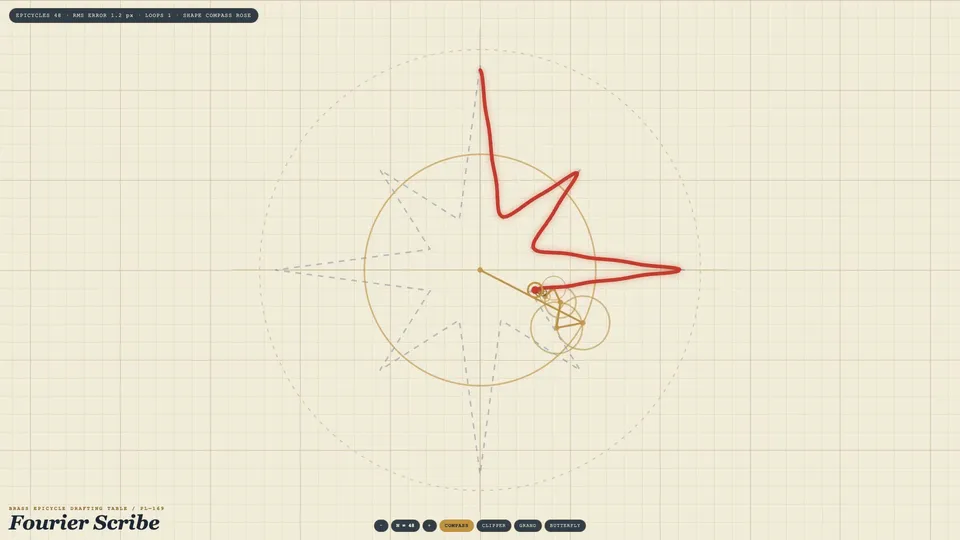
Spinning circles that draw a curve: an exact Fourier transform, pure SVG and CSS animation, measurable error and freehand sketch decomposition.
Download fileMade for ChatGPT, Claude, Gemini, Grok and other AI tools
How to run
- Download the file or copy the prompt.
- Upload or paste it into any AI chat or coding tool, and send.
- Save the HTML it gives you as a file and open it in Chrome.
- Open it with ?test=1 and look in the browser console for the TEST lines.
What it tests
Spinning circles that draw a curve: an exact Fourier transform, pure SVG and CSS animation, measurable error and freehand sketch decomposition.
The checks
- Pure SVG & framing: the scene uses
<svg>with zero<canvas>elements and zero external network requests (performance.getEntriesByType("resource").length === 0), and the drawing + epicycles span at least 65% of screen height. - Exact DFT convergence: on the Compass Rose, raising
harmonicsfrom4to40strictly reduces measuredrmsErrorPxby at least 75% (ending under 4.0 px). - Tip continuity & closure: stepping one full cycle (
t: 0 -> 2*pi) keeps the SVG pen nib within 0.5 px of the analytic Fourier sum at every sampled frame and incrementsloopsCompletedby exactly 1. - Custom sketch DFT: submitting a synthetic square/star stroke computes new Fourier coefficients, increments
customSketchesby 1, and reconstructs the submitted vertices within 6 px RMS at 36 harmonics. - Attract showcase: advancing 28 s hands-free visits >= 3 distinct shapes, completes >= 2 full loops, and logs zero console errors.
Runs by model
- Gemini 4 Neon Highvia Devin Desktop chat2026-11-19First tryAgent checkPass60 fps
Show the full prompt
FOURIER SCRIBE: Spinning Epicycles Draw Live
HOOK OBJECT: window.__fourier

Build "FOURIER SCRIBE": an illuminated drafting-table epicycle machine in pure SVG and CSS (no canvas, no WebGL, no libraries). A live Discrete Fourier Transform decomposes any closed silhouette — from a compass rose, sailing ship, grand treble clef, or your own freehand mouse/finger sketch — into a chain of spinning brass-and-ink epicycle gears whose final pen tip traces the exact picture in glowing crimson ink.

LOOK
- Style: architectural brass drafting vellum, palette warm cream vellum #F4ECDC, drafting grid #DDD1B8, compass ink #253242, brass circle #C49545, glowing stylus trail #C83E32, ghost blueprint #5B7898.
- Subject: a full-viewport SVG drafting sheet with fine millimeter rulings, a chain of up to 48 nested rotating SVG circles (`<circle>`) and radial brass arms (`<line>`) sorted from largest amplitude to smallest, a glowing pen nib drawing the reconstructed closed `<path>` in real time, and a faint target guide underneath.
- FIRST FRAME (t = 0, no input): the drafting table and spinning epicycle chain (already 35% through tracing the Compass Rose so both the nested gears and crisp ink trail read immediately) fill at least 72% of the screen height, with clean top-left telemetry away from the drawing.

MOTION / PLAY
- Controls: click/drag directly on the vellum to sketch any custom closed shape (on release, the real DFT computes exact complex Fourier coefficients and immediately begins redrawing your sketch with spinning circles!); keys 1–4 or shape buttons switch built-in vector paths (COMPASS ROSE, CLIPPER SHIP, GRAND CLEF, BUTTERFLY); +/- or a harmonics slider varies active epicycles from `N = 3` (blobby low-pass) up to `N = 48` (razor-sharp reconstruction); Space pauses/resumes; `setCamera(panX, panY, zoom)` zooms smoothly into the spinning tip!
- Exact Discrete Fourier Transform: real complex DFT `X[k] = (1/M) * sum(z[m] * exp(-i*2*pi*k*m/M))` computed in code over the sampled contour points, sorted by descending magnitude `|X[k]|`, reconstructing `z(t) = sum(X[k] * exp(i*k*t))` with zero hardcoded circle animations!
- ATTRACT MODE: with no input, a hands-free 28–30 s drafting showcase runs on load: completes the Compass Rose while ramping harmonics from 6 -> 48 so viewers watch the crude loop sharpen into crisp artwork, switches to Clipper Ship, then Grand Clef, zooming briefly onto the tiny fast outer gears. Any input takes over; after 8 s idle it resumes.

SOUND
- Spinning epicycles -> soft harmonic chord built from the top 4 active Fourier frequencies (changes timbre as you raise or lower harmonics!).
- Pen tip tracing fast curves -> delicate pencil-on-vellum scratch modulated by tip speed.
- Completed closed loop -> crisp drafting-bell chime; switching shapes -> paper-turn rustle.

COUNTERS
stats() returns { fps, harmonics, loopsCompleted, shapesDrawn, rmsErrorPx, customSketches }.
- harmonics: exact number of currently active spinning epicycle circles (`3` to `48`).
- loopsCompleted: +1 each time the phase wraps a full `2*pi` cycle and closes the ink curve. Never on load.
- shapesDrawn: count of distinct shapes reconstructed (starts at 1, +1 on each shape switch or custom sketch).
- rmsErrorPx: real measured root-mean-square pixel distance between the `harmonics`-term Fourier reconstruction and the target contour!
- customSketches: +1 each time a user/scripted freehand sketch is transformed via DFT and drawn.
- On screen: top-left pill "EPICYCLES NN · RMS ERROR N.N px · LOOPS N · SHAPE <NAME>", never over the drawing.

CHECKS for ?test=1
With ?test=1, run an accelerated self-test that measures real positions and real events (not self-set flags) and logs "TEST n PASS" or "TEST n FAIL: reason" to the console and to window.__testResults:
1. Pure SVG & framing: the scene uses `<svg>` with zero `<canvas>` elements and zero external network requests (`performance.getEntriesByType("resource").length === 0`), and the drawing + epicycles span at least 65% of screen height.
2. Exact DFT convergence: on the Compass Rose, raising `harmonics` from `4` to `40` strictly reduces measured `rmsErrorPx` by at least 75% (ending under 4.0 px).
3. Tip continuity & closure: stepping one full cycle (`t: 0 -> 2*pi`) keeps the SVG pen nib within 0.5 px of the analytic Fourier sum at every sampled frame and increments `loopsCompleted` by exactly 1.
4. Custom sketch DFT: submitting a synthetic square/star stroke computes new Fourier coefficients, increments `customSketches` by 1, and reconstructs the submitted vertices within 6 px RMS at 36 harmonics.
5. Attract showcase: advancing 28 s hands-free visits >= 3 distinct shapes, completes >= 2 full loops, and logs zero console errors.

KEEP IT SHORT
- Keep the whole file under about 1,500 lines (soft target) so you can write it in one pass and finish well inside 15 minutes.
- Save lines with helpers, loops and instancing, not by dropping features. Everything above must really work: no placeholders, no TODOs.

BUILD RULES (all required):
- Deliver ONE self-contained HTML file: inline CSS and JS, no build step, no local assets. Libraries only from a CDN. If you use Three.js, use exactly this import map: {"imports":{"three":"https://cdn.jsdelivr.net/npm/three@0.160.0/build/three.module.js","three/addons/":"https://cdn.jsdelivr.net/npm/three@0.160.0/examples/jsm/"}}
- It must open straight from disk in desktop Chrome and on an iPhone (Safari), fill the full screen, handle resize and touch, and stay smooth (target 60 fps).
- It must look stunning in the very FIRST frame: no black screen, no loading wait, no tiny subject. The main subject fills at least 50% of the screen height.
- SOUND (required): all sound is made in code with Web Audio (no audio files). Show a small "🔊 TAP FOR SOUND" chip; on the first tap create ONE AudioContext, route everything through a master gain of 0.6 into a DynamicsCompressor, and hide the chip. Also expose enableAudio() on the hook object named at the top.
- Expose the hook object named at the top with: setCameraOrbit(azimuthDeg, elevationDeg, distance) (or an equivalent camera setter), advance(seconds) that steps the simulation exactly that much for still captures, enableAudio(), and stats() returning {fps, ...the counters named above}. Use a fixed random seed of 360 so every run is the same.
- Every on-screen counter must count a real event you can see happen. No fake numbers.
- No text overlapping the subject; any label must be readable in a paused frame.
- No brand logos, no real people, no copyrighted characters, brand names or logos.

FAILURE MODES TO AVOID
- Hardcoding fake spinning circles instead of running a real Discrete Fourier Transform on the contour points.
- Using a `<canvas>` element when the prompt specifies pure SVG + CSS.
- Unsorted epicycles where huge and tiny circles jitter chaotically instead of cascading smoothly from largest to smallest.
- `rmsErrorPx` faked or stuck at a constant instead of decreasing visibly as harmonics increase.
- Labels covering the epicycle chain or traced silhouette.
- The same variable declared twice, or methods called on objects that don't exist yet.

SELF-TEST LOOP
- If you can run code: build the file, open it, read the console, run ?test=1, and take screenshots at 3 s, 10 s and 30 s at 1280x720 and 390x844. Look at the screenshots and fix what looks wrong. Fix and retest until all 5 checks pass with zero console errors. Mark anything you could not run as UNMEASURED; never invent results.
- If you are chat-only: go through this prompt line by line, check your code against each line, and fix anything that would fail. Then write one corrected, complete file.
- Final answer: ONE complete HTML file in ONE code block, then the 5 checks marked PASS, FAIL or UNMEASURED. No snippets, no "rest unchanged".
Built one? Post it on X and tag @wikiwaynePost on X