Chladni Plate
PL-166HardFluids & particlesWebGL shaders
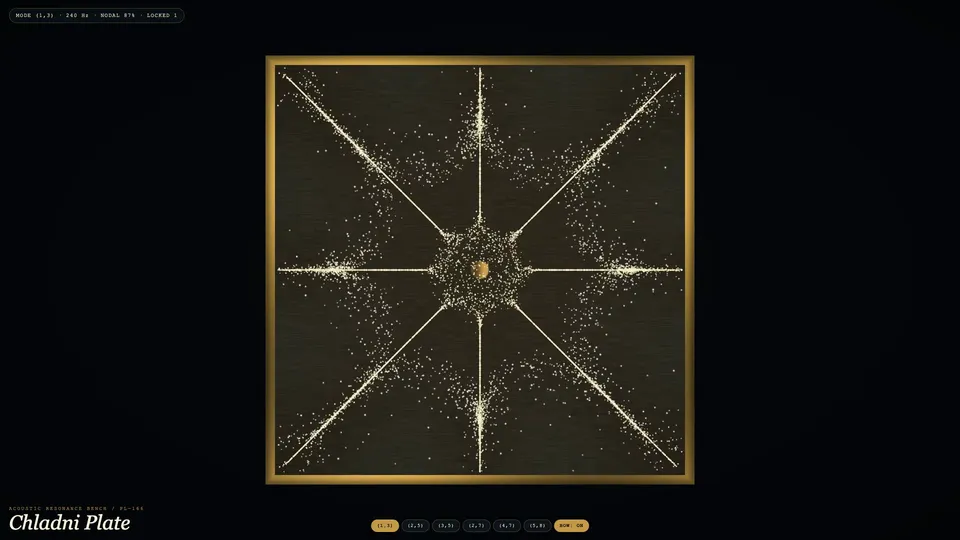
16,000 sand grains on a vibrating plate in raw WebGL2: real standing-wave patterns, grains settling on still lines and pitch-matched sound.
Download fileMade for ChatGPT, Claude, Gemini, Grok and other AI tools
How to run
- Download the file or copy the prompt.
- Upload or paste it into any AI chat or coding tool, and send.
- Save the HTML it gives you as a file and open it in Chrome.
- Open it with ?test=1 and look in the browser console for the TEST lines.
What it tests
16,000 sand grains on a vibrating plate in raw WebGL2: real standing-wave patterns, grains settling on still lines and pitch-matched sound.
The checks
- Scale & zero network: grains === 16000, brass plate fills at least 70% of screen height, and
performance.getEntriesByType("resource").length === 0. - Nodal self-assembly: starting from a uniform random grain distribution under mode (3, 5), advancing 4 s raises
nodalRatiofrom < 0.25 to >= 0.75 while all 16,000 grains stay within the plate bounds. - Mode switching physics: switching from locked mode (3, 5) to mode (2, 7) immediately drops
nodalRatiobelow 0.35 (proving grains really sat on the old nodes), then advancing 4 s re-locksnodalRatio >= 0.72and incrementsmodesLockedby 1. - Bow-off quiescence: disabling excitation (
drive = 0) halts stochastic bouncing so mean grain displacement per frame drops below 0.0005 plate units within 0.5 s. - Attract showcase: advancing 28 s hands-free visits >= 4 distinct (n, m) modes, records
modesLocked >= 3, and logs zero console errors.
Runs by model
- Gemini 4 Neon Highvia Devin Desktop chat2026-11-19First tryAgent checkPass60 fps
Show the full prompt
CHLADNI PLATE: Sand Patterns That Sing
HOOK OBJECT: window.__chladni

Build "CHLADNI PLATE": an acoustic resonance bench in raw WebGL2 and GLSL (no Three.js, no libraries) where 16,000 gleaming quartz sand grains bounce across a dark brushed-brass square plate driven by a pure harmonic oscillator. Sweeping the driving frequency visibly shakes grains off anti-nodes and herds them into razor-sharp geometric Chladni nodal figures, while the exact standing-wave pitch rings in sync.

LOOK
- Style: dark museum acoustics bench, palette obsidian studio #080A0F, dark brushed brass plate #262018 with bevel trim #C89B4B, illuminated quartz sand #FFF1CC, subtle nodal shimmer #7FD8FF, mode indicator #E6A94C.
- Subject: a centered square brass Chladni plate (filling at least 72% of screen height) with central mounting bolt, fine brushed metallic grain rendered in GLSL, 16,000 individual WebGL2 point-sprite sand grains with specular glint, and a live harmonic frequency strip along the side or bottom never overlapping the plate.
- FIRST FRAME (t = 0, no input): the lit brass plate fills 72%+ of screen height, with 16,000 grains already half-assembled into crisp mode (3, 5) nodal arcs so the glowing geometry reads immediately on frame 0.

MOTION / PLAY
- Controls: drag horizontally across the frequency slider or press Left/Right (or keys 1–6) to step through resonant (n, m) eigenmodes (1,3), (2,5), (3,5), (3,7), (4,7), (5,8); click/tap anywhere on the plate to scatter a fresh pinch of grains and disturb the local pattern; Space toggles BOW/DRIVE excitation; setCamera(panX, panY, zoom) zooms into individual grain clusters.
- Standing-wave physics: exact Chladni eigenfunction `W(x, y) = cos(n*pi*x)*cos(m*pi*y) - cos(m*pi*x)*cos(n*pi*y)` (smoothly interpolating frequency between modes). Each of the 16,000 grains computes local vibration amplitude `|W(x, y)|`: grains on high-amplitude anti-nodes receive stochastic upward/lateral kicks proportional to `|W|` and bounce rapidly until they settle along the quiet zero-amplitude nodal lines (`|W| < 0.08`)!
- ATTRACT MODE: with no input, a hands-free 28–30 s acoustic showcase sweeps smoothly through 5 distinct resonant modes, pausing on each so the sand visibly snaps from chaotic buzzing into crisp geometric lacework before jumping to the next harmonic pitch. Any input takes over; after 8 s idle it resumes.

SOUND
- Plate oscillator -> pure warm harmonic sine + subtle metallic overtone whose pitch matches the active Chladni mode frequency in Hz (220 Hz to 1,180 Hz).
- Anti-node grain bounce -> crisp sandy sizzle volume proportional to the fraction of currently buzzing grains (quiets down as the figure locks in!).
- Mode jump / bow attack -> resonant brass bow swell.

COUNTERS
stats() returns { fps, grains, freqHz, modeN, modeM, nodalRatio, modesLocked }.
- grains: exact particle count (16,000).
- freqHz: current driving frequency in Hz.
- nodalRatio: real measured fraction (0 to 1) of grains currently sitting on quiet nodal zones (`|W(x, y)| < 0.12`).
- modesLocked: +1 each time a newly selected eigenmode crosses `nodalRatio >= 0.72` (once per mode switch). Never on load.
- On screen: top-left pill "MODE (n,m) · NNN Hz · NODAL NN% · LOCKED N", never over the plate.

CHECKS for ?test=1
With ?test=1, run an accelerated self-test that measures real positions and real events (not self-set flags) and logs "TEST n PASS" or "TEST n FAIL: reason" to the console and to window.__testResults:
1. Scale & zero network: grains === 16000, brass plate fills at least 70% of screen height, and `performance.getEntriesByType("resource").length === 0`.
2. Nodal self-assembly: starting from a uniform random grain distribution under mode (3, 5), advancing 4 s raises `nodalRatio` from < 0.25 to >= 0.75 while all 16,000 grains stay within the plate bounds.
3. Mode switching physics: switching from locked mode (3, 5) to mode (2, 7) immediately drops `nodalRatio` below 0.35 (proving grains really sat on the old nodes), then advancing 4 s re-locks `nodalRatio >= 0.72` and increments `modesLocked` by 1.
4. Bow-off quiescence: disabling excitation (`drive = 0`) halts stochastic bouncing so mean grain displacement per frame drops below 0.0005 plate units within 0.5 s.
5. Attract showcase: advancing 28 s hands-free visits >= 4 distinct (n, m) modes, records `modesLocked >= 3`, and logs zero console errors.

KEEP IT SHORT
- Keep the whole file under about 1,500 lines (soft target) so you can write it in one pass and finish well inside 15 minutes.
- Save lines with helpers, loops and instancing, not by dropping features. Everything above must really work: no placeholders, no TODOs.

BUILD RULES (all required):
- Deliver ONE self-contained HTML file: inline CSS and JS, no build step, no local assets. Libraries only from a CDN. If you use Three.js, use exactly this import map: {"imports":{"three":"https://cdn.jsdelivr.net/npm/three@0.160.0/build/three.module.js","three/addons/":"https://cdn.jsdelivr.net/npm/three@0.160.0/examples/jsm/"}}
- It must open straight from disk in desktop Chrome and on an iPhone (Safari), fill the full screen, handle resize and touch, and stay smooth (target 60 fps).
- It must look stunning in the very FIRST frame: no black screen, no loading wait, no tiny subject. The main subject fills at least 50% of the screen height.
- SOUND (required): all sound is made in code with Web Audio (no audio files). Show a small "🔊 TAP FOR SOUND" chip; on the first tap create ONE AudioContext, route everything through a master gain of 0.6 into a DynamicsCompressor, and hide the chip. Also expose enableAudio() on the hook object named at the top.
- Expose the hook object named at the top with: setCameraOrbit(azimuthDeg, elevationDeg, distance) (or an equivalent camera setter), advance(seconds) that steps the simulation exactly that much for still captures, enableAudio(), and stats() returning {fps, ...the counters named above}. Use a fixed random seed of 360 so every run is the same.
- Every on-screen counter must count a real event you can see happen. No fake numbers.
- No text overlapping the subject; any label must be readable in a paused frame.
- No brand logos, no real people, no copyrighted characters, brand names or logos.

FAILURE MODES TO AVOID
- Drawing a static contour shader of the Chladni math instead of actually moving 16,000 particles.
- Grains freezing into a blurred fog or escaping off the edges of the brass plate.
- Audio pitch staying constant instead of tracking the live resonant mode frequency.
- Counters incrementing on a timer rather than measuring real grain nodal ratios.
- HUD overlapping the brass plate.
- The same variable declared twice, or methods called on objects that don't exist yet.

SELF-TEST LOOP
- If you can run code: build the file, open it, read the console, run ?test=1, and take screenshots at 3 s, 10 s and 30 s at 1280x720 and 390x844. Look at the screenshots and fix what looks wrong. Fix and retest until all 5 checks pass with zero console errors. Mark anything you could not run as UNMEASURED; never invent results.
- If you are chat-only: go through this prompt line by line, check your code against each line, and fix anything that would fail. Then write one corrected, complete file.
- Final answer: ONE complete HTML file in ONE code block, then the 5 checks marked PASS, FAIL or UNMEASURED. No snippets, no "rest unchanged".
Built one? Post it on X and tag @wikiwaynePost on X