Disclosure: As an Amazon Associate I earn from qualifying purchases. This site contains affiliate links.

Grokipedia: The Complete Guide to xAI's AI Encyclopedia

Local LLMs on NVIDIA Spark / ASUS GX10
Grokipedia: The Complete Guide to xAI's AI Encyclopedia
When xAI launched Grokipedia in October 2025, it was met with a mix of fascination and skepticism. An AI-generated encyclopedia with over 6 million articles, updated in real time, written by Grok? It sounded like either the future of knowledge or a hallucination factory at scale.
Four months later, the picture is clearer. Grokipedia has become a genuinely useful research tool with some significant caveats. I've been using it daily alongside Wikipedia, Perplexity, and traditional search engines, and I have a nuanced take on where it excels, where it falls short, and how to get the most out of it.
What Is Grokipedia?
Grokipedia is an AI-generated encyclopedia created by xAI, the artificial intelligence company founded by Elon Musk. Launched on October 30, 2025, it uses Grok -- xAI's large language model -- to automatically generate, update, and maintain encyclopedia-style articles on virtually every topic imaginable.
The scale is staggering: over 6 million articles at launch, covering everything from quantum physics to obscure historical figures to current events that happened hours ago. That's roughly the same size as English Wikipedia, which took over 20 years of collaborative human effort to build.
But the comparison to Wikipedia is both inevitable and misleading. Grokipedia and Wikipedia are fundamentally different in their approach, strengths, and weaknesses.

How Grokipedia Works
Grokipedia's articles are generated by Grok, which synthesizes information from multiple sources -- X (formerly Twitter) posts, news articles, academic papers, and existing web content. The key differentiators from traditional encyclopedias:
1. AI-generated content. Every article is written by Grok, not human editors. This enables the massive scale but also introduces the limitations inherent in large language model outputs.
2. Real-time updates. Unlike Wikipedia, which relies on volunteer editors to update articles, Grokipedia can refresh content automatically as new information becomes available. An article about a breaking news event can exist within minutes.
3. X integration. Grokipedia draws heavily from X for current events, trending topics, and public discourse. This gives it a unique perspective on topics being actively discussed but also introduces bias toward whatever is trending on X.
4. Comprehensive coverage. Because generating an article costs computation rather than human labor, Grokipedia covers many niche topics that Wikipedia's editors haven't gotten to. Obscure software libraries, minor historical events, local landmarks -- the long tail is where Grokipedia often outshines human-edited alternatives.
Grokipedia vs. Wikipedia: An Honest Comparison
This is the question everyone asks, so let me address it directly with a comparison based on months of side-by-side use.
| Aspect | Grokipedia | Wikipedia |
|---|---|---|
| Article Count | 6M+ | 6.8M+ (English) |
| Update Speed | Real-time (minutes) | Variable (hours to months) |
| Content Creation | AI-generated by Grok | Human-written, collaboratively edited |
| Accuracy | Good (with caveats) | Very Good (with sources) |
| Citations | Sometimes present, less rigorous | Required and extensively sourced |
| Bias | Reflects training data + X trends | Editorial bias, systemic gaps |
| Niche Coverage | Extensive (AI generates easily) | Varies (depends on editor interest) |
| Current Events | Excellent | Good (active community) |
| Controversial Topics | Less moderated | Extensively debated/moderated |
| Editing | Automated | Open to public |
| Cost | Free (with X/Grok account) | Free |
| Trust Level | Developing | Established |
Where Grokipedia Wins
Speed on current events. When a major news story breaks, Grokipedia often has an article within an hour. Wikipedia's version might take longer due to the editorial process, sourcing requirements, and notability debates.
Niche topic coverage. Search for a specific Python library, a minor historical battle, or a local geographic feature, and Grokipedia often has content where Wikipedia has nothing. The cost of generating an article is essentially zero, so the threshold for coverage is much lower.
Readability. Grokipedia articles tend to be well-structured and clearly written. Grok produces clean prose that's accessible to general audiences, while some Wikipedia articles suffer from inconsistent quality, committee-style editing, or academic jargon.
Where Wikipedia Wins
Citations and verifiability. This is the big one. Wikipedia's strength has always been its citation culture -- every factual claim should be backed by a verifiable source. Grokipedia's sourcing is inconsistent. Some articles cite sources, many don't, and when they do, the citations aren't always accurate.
Accuracy on established topics. For well-established subjects (major historical events, scientific concepts, notable people), Wikipedia's years of collaborative editing and fact-checking produce more reliable content than Grokipedia's AI-generated articles.
Community moderation. Wikipedia's editorial community, for all its flaws, provides a layer of human judgment that catches errors, removes vandalism, and enforces neutrality policies. Grokipedia's moderation is primarily automated.
Accuracy: The Critical Question
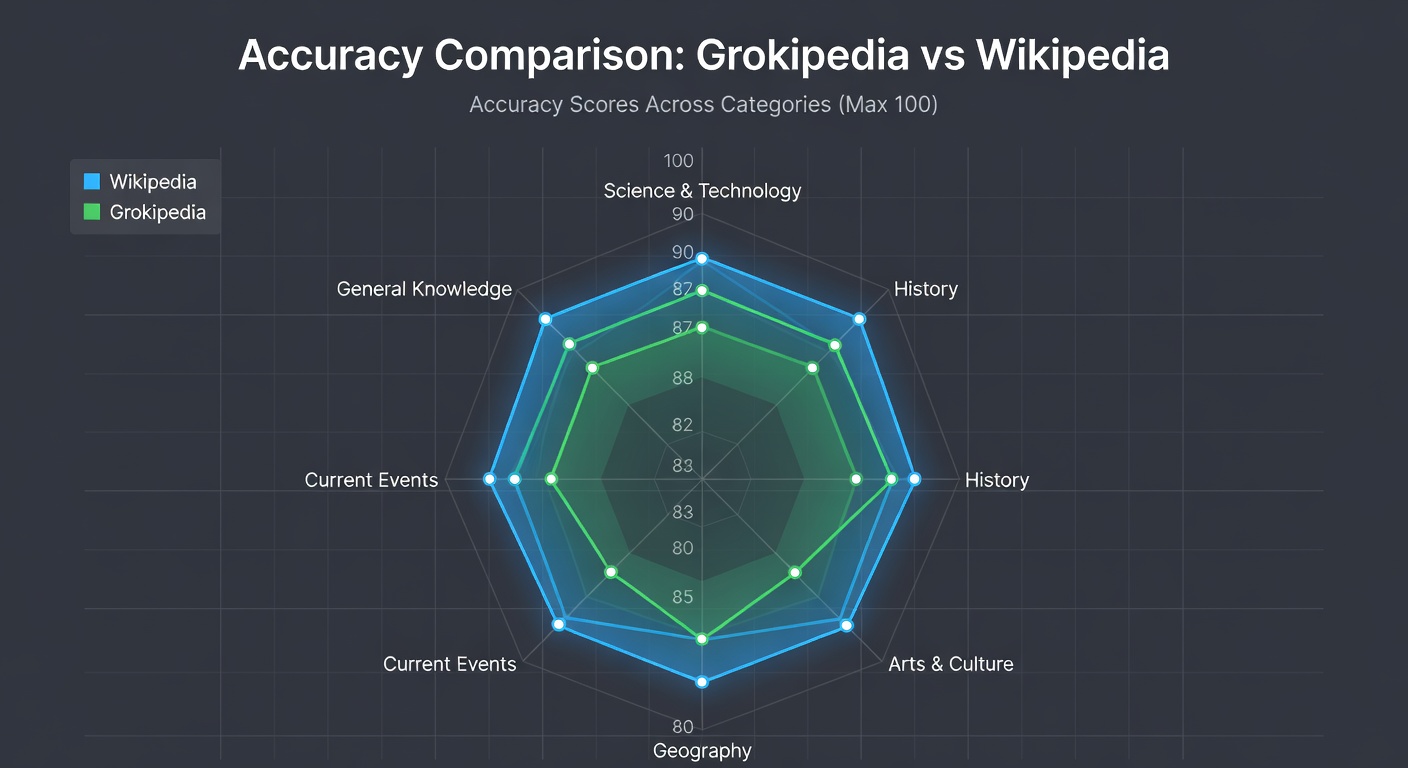
Let me be direct: Grokipedia's accuracy is good enough to be useful but not reliable enough to cite without verification.
In my testing across 50+ articles on topics I know well:
- Factual accuracy on major topics: ~90-95% correct
- Accuracy on niche or recent topics: ~80-85% correct
- Completeness compared to Wikipedia: Varies widely
- Hallucination rate: Noticeable but not overwhelming
The hallucinations are the real concern. I've encountered articles that confidently state incorrect dates, attribute quotes to the wrong people, or describe events that didn't quite happen the way Grokipedia claims. These errors are plausible-sounding, which makes them harder to catch than obvious mistakes.
My rule of thumb: Use Grokipedia for overview and discovery, but verify any specific fact through primary sources before relying on it.
Controversies and Criticism
Grokipedia hasn't been without its detractors, and some of the criticism is warranted.
The bias question. Because Grokipedia draws heavily from X for current events and cultural context, it inherits whatever biases exist in X's user base and algorithmic curation. Critics have noted that articles on politically sensitive topics sometimes reflect X's discourse patterns rather than a neutral encyclopedic tone.
Copyright concerns. The question of whether AI can ethically generate encyclopedia articles by synthesizing information from copyrighted sources is unresolved. Some publishers have raised objections, and the legal landscape is evolving.
The "replacing human knowledge" debate. Academics and Wikipedia editors have expressed concern that AI-generated encyclopedias could undermine the culture of collaborative knowledge-building that Wikipedia represents. If AI can generate articles faster and cheaper, what happens to the volunteer editors?
Quality control. With 6 million AI-generated articles, quality control is a mathematical challenge. Errors in niche articles may go undetected for long periods because there aren't human editors reviewing them.
How to Use Grokipedia Effectively
After months of daily use, here are my best practices:
1. Use It for Exploration and Discovery
Grokipedia excels as a starting point for research. Its broad coverage and readable summaries make it ideal for getting an overview of a topic you're unfamiliar with. Think of it as your first stop, not your only stop.
2. Cross-Reference Important Facts
Never cite Grokipedia as your sole source for important facts. Cross-reference with Wikipedia, primary sources, or established reference materials. This is good practice with any encyclopedia, but it's especially important with AI-generated content.
3. Leverage the Real-Time Updates
For current events and trending topics, Grokipedia's speed is a genuine advantage. It can provide context on breaking news faster than any human-edited source. Just remember that speed and accuracy are often in tension.
4. Explore Niche Topics
This is where Grokipedia delivers the most unique value. Topics that Wikipedia's volunteer editors haven't covered -- specific software tools, local history, minor cultural phenomena -- often have surprisingly good articles on Grokipedia.
5. Use the Grok Integration
Grokipedia articles include the ability to ask Grok follow-up questions, essentially turning every article into an interactive research session. This is powerful for drilling into specific aspects of a topic.
Grokipedia for Content Creators and Researchers
If you're a content creator, blogger, or researcher, Grokipedia has some practical applications:
Topic research. Quickly get up to speed on a subject before deep-diving into primary sources. The structured article format makes it easy to identify subtopics and angles worth exploring.
Trend identification. Because of the X integration, Grokipedia surfaces topics that are currently being discussed. This can be useful for content planning and identifying emerging trends.
Background context. When writing about a specific tool, technology, or concept, Grokipedia articles can provide the broader context you need. I use it regularly as background research for WikiWayne articles.
For more on how AI is changing research and content workflows, check out my guides to AI writing assistants and AI productivity tools.
If you want to understand the technical foundations behind systems like Grokipedia, I'd recommend AI Engineering by Chip Huyen. It covers the architecture and design patterns that make large-scale AI knowledge systems possible, and Designing Machine Learning Systems goes even deeper into the infrastructure side.
The Bigger Picture: AI-Generated Knowledge
Grokipedia represents something larger than a single product. It's the first major attempt at building an AI-generated knowledge base at encyclopedia scale, and it raises fundamental questions about how we create, curate, and consume knowledge in the AI era.
The traditional model -- human experts writing, editing, and citing sources -- produces high-quality knowledge but doesn't scale easily. The AI model -- automated generation from synthesized sources -- scales infinitely but introduces reliability concerns.
The most likely future isn't one or the other. It's a hybrid where AI generates initial content at scale, human editors verify and improve critical articles, and users develop the literacy to evaluate AI-generated information appropriately.
Grokipedia is an early draft of that future. It's imperfect, sometimes wrong, and occasionally brilliant. Using it well means understanding its strengths and limitations -- treating it as one tool in your research toolkit, not as a replacement for critical thinking.
FAQs
Is Grokipedia free to use?
Yes, Grokipedia is free to access. You can browse articles without an account. Some features, like asking Grok follow-up questions, may require an X or Grok account.
Is Grokipedia more accurate than Wikipedia?
Generally, no. Wikipedia's citation-based editing model and 20+ years of community review make it more reliable for established topics. Grokipedia's advantage is speed and breadth of coverage, not accuracy. Always cross-reference important facts.
Can I cite Grokipedia in academic work?
I wouldn't recommend it, for the same reason most professors don't accept Wikipedia citations -- encyclopedias are starting points for research, not primary sources. AI-generated encyclopedias carry additional reliability concerns. Use Grokipedia to find topics and leads, then cite the primary sources.
How does Grokipedia handle controversial topics?
With less moderation than Wikipedia. Grokipedia articles on politically or socially sensitive topics may reflect the biases of Grok's training data and X's discourse patterns. Read these articles critically and seek multiple perspectives.
Will Grokipedia replace Wikipedia?
Unlikely in the near term. Wikipedia's community, editorial processes, and established trust are significant moats. More likely, they'll coexist -- Grokipedia serving users who want quick, comprehensive overviews, and Wikipedia serving users who need rigorously sourced, community-verified information.
The Bottom Line
Grokipedia is a fascinating and genuinely useful tool that represents a new paradigm in knowledge organization. It's not a Wikipedia replacement, and it shouldn't be treated as one. But as a complement to traditional research sources -- a fast, broad, readable entry point into virtually any topic -- it fills a real gap.
My recommendation: add it to your research toolkit alongside Wikipedia, Perplexity, and traditional search. Use it for exploration, niche topics, and current events. Verify anything important. And keep your critical thinking engaged -- that's good advice for any information source, AI-generated or otherwise.
Have you been using Grokipedia? What's been your experience with accuracy and usefulness? I'd love to hear your take on X (@wikiwayne) -- especially if you've found it useful for specific research workflows.
Recommended Gear
These are products I personally recommend. Click to view on Amazon.
AI Engineering by Chip Huyen — Great pick for anyone following this guide.
Designing ML Systems by Chip Huyen — Great pick for anyone following this guide.
 Prompt Engineering for Generative AI — Great pick for anyone following this guide.
 ASUS ProArt PA279CRV 27" 4K — Great pick for anyone following this guide.
 Sony WH-1000XM5 — Great pick for anyone following this guide.
 Logitech MX Keys S Wireless — Great pick for anyone following this guide.
This article contains affiliate links. As an Amazon Associate I earn from qualifying purchases. See our full disclosure.
Affiliate Disclosure: As an Amazon Associate I earn from qualifying purchases. This site contains affiliate links.