Hexagon Pinball Storm v2
PL-072HardPhysics playgroundsCanvas 2D
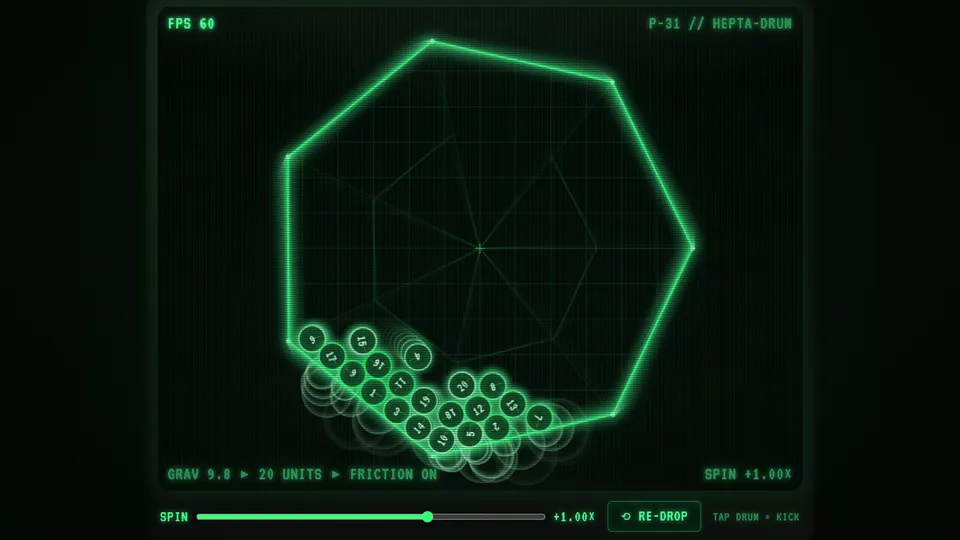
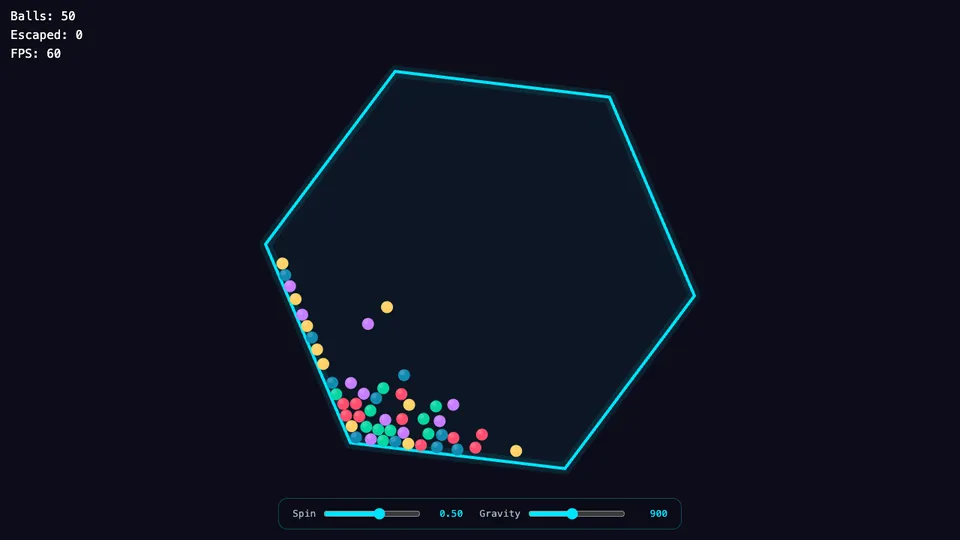
The hexagon pinball toy again, with a shorter plan-first prompt and a stated collision method: fifty balls, no tunneling, and zero escapes.
Download fileMade for ChatGPT, Claude, Gemini, Grok and other AI tools
How to run
- Download the file or copy the prompt.
- Upload or paste it into any AI chat or coding tool, and send.
- Save the HTML it gives you as a file and open it in Chrome.
What it tests
The hexagon pinball toy again, with a shorter plan-first prompt and a stated collision method: fifty balls, no tunneling, and zero escapes.
Runs by model
7 models tried this prompt on a first try; 4 passed. Showing 4.
- swe-2-flash-maxvia Devin CLI2026-11-06First tryTest rig (automatic)Pass60 fps
- swe-2-highvia Devin CLI2026-11-07First tryTest rig (automatic)Pass60.1 fps
- swe-2-flash-highvia Devin CLI2026-11-06First tryTest rig (automatic)Pass60 fps
- swe-2-maxvia Devin CLI2026-11-07First tryTest rig (automatic)Pass60 fps
Older version: Hexagon Pinball Storm
Show the full prompt
PL-072 "Hexagon Pinball Storm v2": build a 2D physics toy in a single HTML file using Canvas 2D and your OWN physics code (no physics library).

- Dark background #0d0d1a. A large regular hexagon (outline 4px #00e5ff) centered on screen, rotating at 0.5 rad/s. The hexagon fills 80% of the shorter screen side.
- 50 balls (radius 8px, 5 colors: #ff4d6d #ffd166 #06d6a0 #118ab2 #c77dff, 10 each), seed 72. Gravity 900 px/s². Restitution 0.85 for walls, 0.9 between balls. Friction from the spinning walls must visibly drag balls around.
- Use fixed-step physics (at least 4 substeps per frame) so fast balls never tunnel through walls.
- Press Space or tap with two fingers to give every ball an upward kick of 600 px/s.
- Slider "Spin" from -3 to 3 rad/s, slider "Gravity" from 0 to 2000.
- Top-left panel in 16px white monospace: "Balls: 50", "Escaped: N", "FPS: N". Escaped counts only balls whose center leaves the hexagon, and it must stay 0.

KEEP IT SHORT (read first)
- Plan in at most 10 short bullet points. Do not debate physics options; use this method: circle-vs-segment collision against the 6 rotating edges in the hexagon's local frame, wall velocity = spin x radius added to the bounce, simple pairwise ball pushes with a uniform grid.
- Write the full index.html early, in one go, then check it. A working file beats a perfect plan. Target under 400 lines of JS.
- If you are unsure about a detail, pick the simplest choice and keep going.

PASS/FAIL CRITERIA
1. The hexagon rotates smoothly and the balls collide with its moving walls.
2. After 60 s (with balls clamped back inside any edge they cross as a safety net), including 10 kicks and spin set to 3, "Escaped" is still 0, and no ball is visibly outside the hexagon.
3. Balls collide with each other with no lasting overlap and no jitter when they come to rest in a pile.
4. Spinning the walls visibly drags the balls around the edge.
5. Both sliders change behavior live, with no reload.
6. Space and two-finger tap both kick the balls.
7. Stays at about 60 fps on a laptop with 50 balls.
8. Zero console errors.


RULES FOR EVERY BUILD
- Output ONE self-contained file named index.html: inline CSS and JS, any library only from a public CDN, no other files, no build step. Add <link rel="icon" href="data:,"> so there is no favicon 404.
- It must open straight from disk in desktop Chrome and on an iPhone in Safari, fill the screen, and resize cleanly with no scrollbars.
- Zero console errors or warnings on load and while interacting.
- Animation runs on requestAnimationFrame and stays smooth (about 60fps on a laptop).

WORK LOOP (do this yourself before answering)
1. Build the file.
2. If you can run code, open it in a browser, read the console, take screenshots at 3 s and 6 s, and test the interactions. If you can't run code, mentally trace the code against the checklist line by line.
3. Mark every checklist item PASS or FAIL. Mark PASS only when it is visibly true on screen, not just present in the code.
4. Fix every FAIL and recheck. Repeat until all items pass.
5. Final answer: the complete index.html in ONE code block, output once, then the checklist with PASS/FAIL. Nothing else.
Built one? Post it on X and tag @wikiwaynePost on X