Eiffel Tower
PL-098HardCities & buildingsThree.js
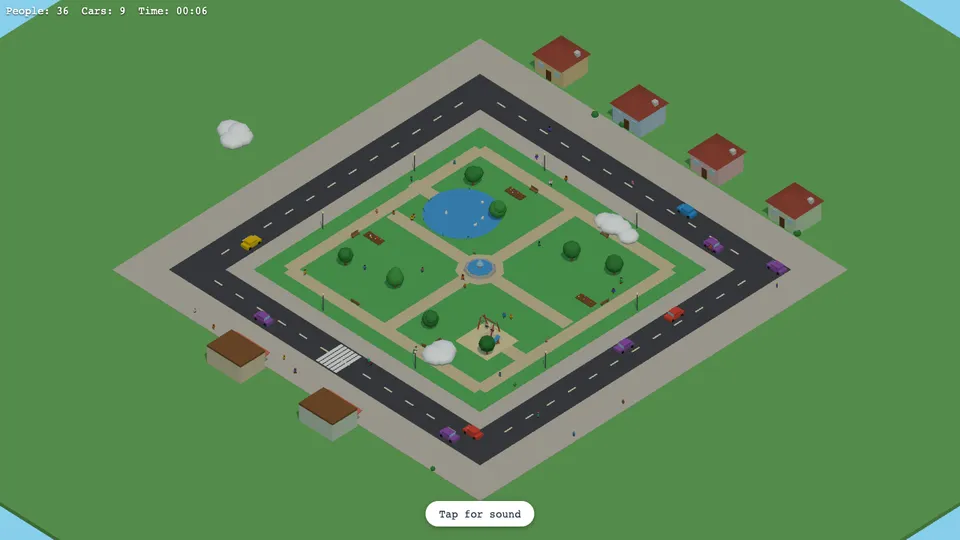
An iron-lattice tower diorama made of cubes: open arches, moving lifts, reversible assembly and a wind response that depends on height.
Eiffel Tower
Download fileMade for ChatGPT, Claude, Gemini, Grok and other AI tools
How to run
- Download the file or copy the prompt.
- Upload or paste it into any AI chat or coding tool, and send.
- Save the HTML it gives you as a file and open it in Chrome.
What it tests
An iron-lattice tower diorama made of cubes: open arches, moving lifts, reversible assembly and a wind response that depends on height.
The checks
- The open iron lattice and all four arches hold up from the rear
- Lift cars follow their tracks, stop and board visibly
- Explode and reassemble restores sampled cubes within 0.01 units
- Wind response is height-weighted, decays and is labeled as an interpretation
Runs by model
No runs posted yet. Be the first: post yours and tag @wikiwayne.
Show the full prompt
PL-098 — EIFFEL TOWER: Iron Lace, Sky Lifts & Wind Orchestra — HARD

Build a detailed interactive 360° voxel Eiffel Tower diorama in ONE self-contained index.html using Three.js. Inline CSS/JS; pinned public-CDN Three.js and OrbitControls only. No external models, images, fonts or audio. All visible world geometry must be actual cubic BoxGeometry instances, efficiently batched with InstancedMesh—not smooth geometry covered in a voxel texture.

ARCHITECTURE
Create a floating Paris-inspired park island with an unmistakable Eiffel Tower: four splayed legs, enormous open archways, two broad observation platforms, tapering upper shaft and antenna. Design targets: 90 units tall, 36-unit square footprint.

Each leg needs at least eight stacked lattice bays. Build diagonal braces as stepped cube chains with real empty space between them. Never substitute solid pyramids with dark painted squares. Use bronze, ochre and charcoal iron, readable rivet-like cubes, railings, platform kiosks and four separate foundations.

Surround it with lawns, pale paths, flower beds, benches, a voxel river strip and at least 12 animated cubic visitors. Finish service paths behind the tower, every island edge, underground foundations and the underside. It must look complete from all 360 degrees.

INTERACTIVE SYSTEMS
1. WORKING SKY LIFTS
Two visible elevator cars follow inclined tracks inside opposite legs to the second platform. A separate vertical car serves the summit. Show tracks, gates and waiting visitors. Cars ease into stations, stop for two seconds, open gates, board or unload passengers, then depart. Include a real transfer pause. No car may travel diagonally through ironwork. Count trips only after actual arrival. Follow Lift camera tracks the selected car without clipping through beams.

2. EXPLODED ENGINEERING
A 0–100% slider separates the four leg assemblies outward and platforms upward, revealing colored connection seats. Braces remain attached to their local assemblies. Lock lifts while exploded. Returning to zero restores every sampled cube within 0.01 units, without duplicates or scene reload. Label this an interpretive assembly—not a historical construction sequence.

3. WIND ORCHESTRA
A wind slider drives exaggerated, height-weighted elastic deflection of the upper structure and flags. Lower sections move less than the summit. Releasing a gust creates a decaying oscillation, not permanent drift. Label this educational motion, not a structural safety prediction. User-triggered gust peaks produce original procedural metallic tones.

LIGHTING AND CAMERA
Provide mouse orbit/wheel and touch orbit/pinch. Auto 360 Tour completes a smooth orbit, rises past platforms and looks upward through the leg arches. Manual input stops touring. Keep the tower framed without hard cuts. Day/Golden/Night lighting preserves readable ironwork, real shadows and warm platform lamps. No muddy black silhouettes.

CONTROLS
Provide Lift Ride, Explode slider, Wind slider, Gust, Time of Day, Auto Tour, Reset, Pause, Mute and Reduced Motion. Targets >=44px, text >=14px, contrast >=4.5:1. Use a collapsible phone panel; collapsed HUD occupies <=25% of 390x844 and does not cover the tower center. Sound unlocks only after user input and follows real events.

PERFORMANCE AND STATE
Target 18,000–65,000 cubes and <=80 main-camera draw calls, excluding shadow passes. Use coherent cube grids of different resolutions where needed. Aim 60fps desktop and 30fps actual mobile; report measured hardware. Desktop phone emulation proves layout, not iPhone GPU performance. Clamp dt to 0.05s, cap DPR at 2, pause hidden tabs, support resize and use seed 360. Include a data favicon.

Expose read-only window.__sim snapshots for actual lift positions, arrival counts, assembly amount, deflection, instance counts and timings. Put actions on window.__controls. Counters change only on observed events.

INDEPENDENT CHECKLIST / ?test=1
1. Opposite screenshots show four grounded feet, open lattice bays and three distinct platform heights.
2. Each car stays within 0.25 units of the actual track; observe two station arrivals and reconcile trip counts.
3. Compare >=200 world instance matrices before explosion and after restoration: maximum position error <=0.01.
4. Upper deflection exceeds lower deflection and decays below 10% of peak within eight seconds after release.
5. Check 360 completeness, night readability, phone controls, batching, finite transforms, deterministic reset and zero console errors.

Sample actual instance matrices multiplied by mesh.matrixWorld over time. Do not prove movement using commanded targets or reconcile counters against their own logs. Retain failed trajectories. Store measured PASS/FAIL/UNMEASURED in window.__testResults and print concise console.info results. Screenshots prove visual recognition, not booleans.

WORK LOOP
Build, run, inspect, fix and retest. Capture 1280x720 and 390x844 from three azimuths, during explosion and at night. Exercise every control. Mark unrun checks UNMEASURED. Chat-only fallback: T2 zero-code audit, then T3 one corrected complete file; never invent results.

Return ONE complete HTML code block followed by the checklist with measured PASS/FAIL/UNMEASURED. No snippets. Use this same prompt unchanged for every model.
Built one? Post it on X and tag @wikiwaynePost on X