Disclosure: As an Amazon Associate I earn from qualifying purchases. This site contains affiliate links.
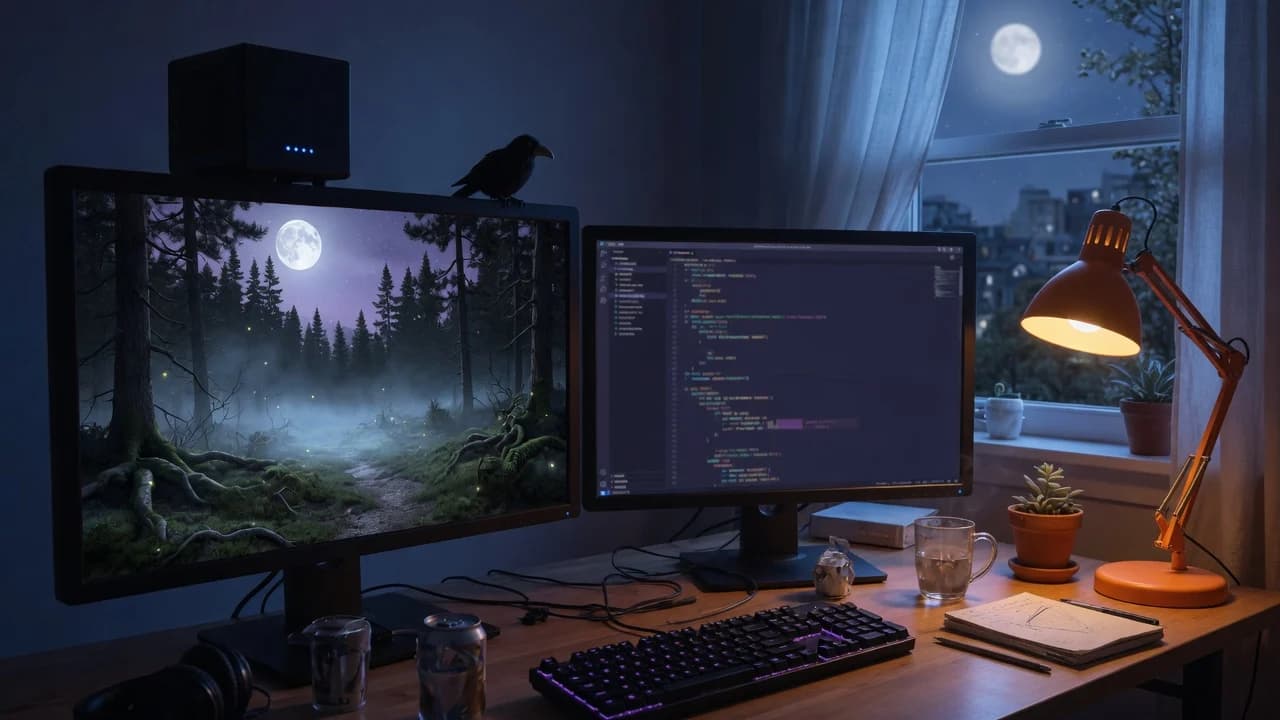
I Built Moon Trail with Hermes + DeepSeek V4 Flash on the GX10
Moon Trail is a real WikiWayne browser game. I built it with a Hermes agent running DeepSeek V4 Flash 0731 on my ASUS Ascent GX10.
Key takeaways
- Moon Trail is a real WikiWayne browser game. I built it with a Hermes agent running DeepSeek V4 Flash 0731 on my ASUS Ascent GX10.
- The rule I posted on X: local model only. No quietly swapping in a frontier cloud API when the agent got stuck.
- Local agents are slower to babysit than Cursor-on-a-frontier-model. They are also the only way to know the box can ship.

Local LLMs on NVIDIA Spark / ASUS GX10
I posted this on X because I needed a witness: Hermes agent, DeepSeek V4 Flash 0731, ASUS Ascent GX10, Moon Trail. Local. I promised not to cheat.
That sentence is the article. Everything below is how it felt to keep the promise.

Why a game, not another chat demo
Chat demos lie. A model can look brilliant for twelve turns of "explain quantization" and then fall apart when you ask it to keep a file tree consistent for two hours.
A game does not let you hide:
- State has to persist (fuel, oxygen, events).
- UI has to render in a browser.
- You either ship a URL or you posted vapor.
Moon Trail is Oregon Trail for a lunar run: ration fuel and oxygen, survive events, try to found Starbase Luna. It now lives on WikiWayne next to Sweater Stack and Token Breaker. The GX10's job was to write and iterate the thing, not to host the production site.
If you want the hardware context, read the GX10 unboxing notes. If you want the general local-model playbook, start at run open-weight models locally.
The stack I actually used
- Box: ASUS Ascent GX10 (NVIDIA GB10 / DGX Spark class, 128GB unified memory).
- Agent: Hermes — the agent loop that can edit files, run commands, and keep a goal.
- Model: DeepSeek V4 Flash, 0731 build, local.
- Constraint: do not silently upgrade to a cloud frontier model when Flash gets stuck.
Flash is the point. Pro and the giant teacher models are what you rent when you want a second opinion. I wanted to know whether a local Flash could carry a small product.
DeepSeek's V4 line is already in the WikiWayne corpus as news and tooling (OpenClaw + V4 era). This post is not a recap of the release. It is "did Flash, on my desk, ship a game."
What local Flash was good at
Scaffolding. Route files, component shells, "make a page that looks like the other games." Hermes + Flash is fast at matching an existing Next.js pattern once you point it at /games.
Iteration. "The event table is unfair." "Oxygen ticks too fast." Flash will patch numbers and copy all afternoon. That is most of game development.
Keeping the joke. Moon Trail needs a tone. Local Flash, given the other WikiWayne games as examples, stayed closer to "dry disaster" than to generic AI quest text.
Where it needed a human
Taste. An agent will add a fifth resource bar because it can. I cut.
When the loop thrashed. Local agents retry. Sometimes they retry the wrong theory. I stopped the loop, wrote the constraint in one sentence, and started it again. That is not failure. That is how you use a 27B–Flash-class coder instead of pretending it is a staff engineer.
I did not let it "just use Grok/Claude for this one function." The whole experiment dies if the hard function is cloud and the easy functions are local. Then you have a hybrid you cannot reproduce on the cube.
Why this is different from vibe-coding in Cursor Ultra
I also posted that I moved from Cursor Pro+ to Cursor Ultra. Different job. Cursor + a frontier model is how I move fast on this site's chrome. The GX10 + Hermes + Flash is how I prove the homelab can create.
Use both. Do not confuse them.
- Frontier cloud: taste, architecture, "why is this Next.js route wrong."
- Local Flash: private repos, games, anything you do not want in a vendor log, and honesty about what 128GB unified memory is for.
The self-hosting guide is still the right on-ramp if you are not buying a Spark cube. Moon Trail is just the first thing I made after the cube arrived.
How to steal the experiment
You do not need a GX10 to try this. You need:
- A local runner (Ollama, llama.cpp, or whatever DGX OS gives you).
- A Flash-class open-weight coder you can actually load. See the model tracker.
- An agent that can touch files (Hermes, OpenClaw, or a dumb script loop).
- A public constraint: one project, local weights only, ship a URL.
If you cheat, you will get a nicer game and a worse measurement. I wanted the measurement.
Play it
Moon Trail: Starship Colony is live. If the rations feel cruel, that was me, not the model.
I will keep using the GX10 for the next small ship. Next candidate is whatever Qwen 3.8 27B wants to build. Follow the messy version on X (@wikiwayne).
Frequently asked questions
A Flash-tier DeepSeek V4 checkpoint (0731 build) I ran locally for the agent loop — coding, file edits, and iteration on Moon Trail. Flash is the fast/cheap sibling, not the giant Pro teacher model.
No. That was the public constraint. Hermes on the GX10, DeepSeek V4 Flash local. If I had cheated, the post would have been a lie.
Yes. It is a free browser game at /games/moontrail — Oregon Trail energy, lunar rations, no install.
Affiliate Disclosure: As an Amazon Associate I earn from qualifying purchases. This site contains affiliate links.