Floating Islands Biplane
PL-084MediumLandscapes & natureThree.js
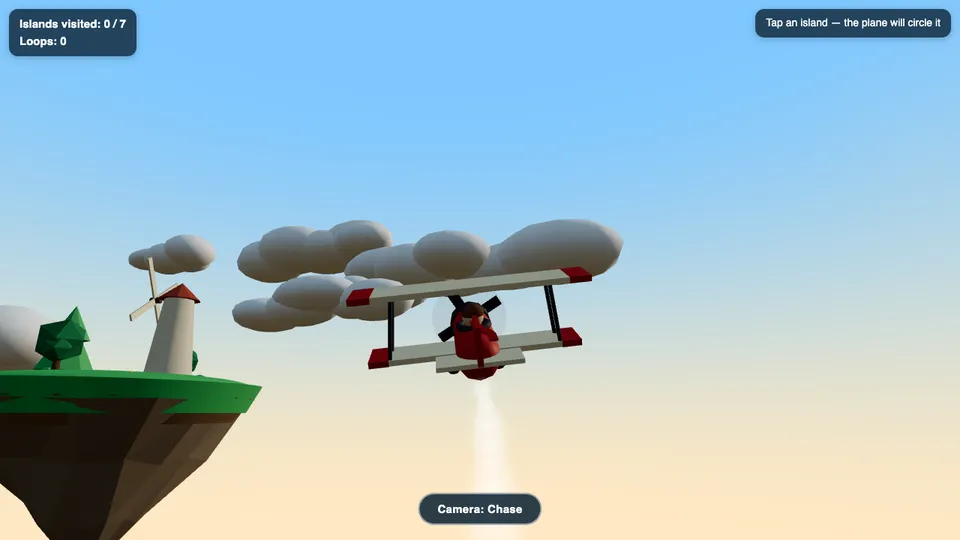
A charming flight over floating islands and waterfalls: path planning with clearance, many small animated parts and camera switching.
Download fileMade for ChatGPT, Claude, Gemini, Grok and other AI tools
How to run
- Download the file or copy the prompt.
- Upload or paste it into any AI chat or coding tool, and send.
- Save the HTML it gives you as a file and open it in Chrome.
What it tests
A charming flight over floating islands and waterfalls: path planning with clearance, many small animated parts and camera switching.
Runs by model
7 models tried this prompt on a first try; 3 passed. Showing 4.
- swe-2-maxvia Devin CLI2026-11-07First tryTest rig (automatic)Pass60 fps
- swe-2-mediumvia Devin CLI2026-11-07First tryTest rig (automatic)Pass60 fps
- swe-2-flash-highvia Devin CLI2026-11-06First tryTest rig (automatic)Pass60 fps
- swe-2-flash-maxvia Devin CLI2026-11-06First tryTest rig (automatic)Fail
No code came back.
Show the full prompt
PL-084 "Floating Islands Biplane": build a charming 3D flight scene of floating islands, waterfalls and a little biplane, in a single HTML file using Three.js (CDN). It must look finished on the first frame.

SCENE
- A bright morning sky (gradient #7fc8ff to #ffe8c2) with 10 or more soft cloud puffs and a pale sun with a lens glow.
- At least 7 floating rock islands of different sizes (3 to 12 units wide) at different heights, each with a rocky underside, a green top, and some with trees (at least 20 trees in total), a small cottage, a windmill whose blades turn, or a stone bridge between two islands. Islands bob slowly up and down by 0.2 to 0.5 units.
- At least 3 waterfalls pouring off island edges, drawn as animated falling water streaks that dissolve into mist before they hit anything, with a soft white spray.
- A small red-and-cream biplane (two stacked wings, round engine with a spinning propeller, tail fin, pilot head with a scarf that flutters, round cockpit) flies a looping path that weaves between islands and around a waterfall, banks into turns, and leaves a thin white smoke trail that fades in 3 s. It must never pass through an island, tree or cottage (keep a 1 unit clearance).
- Camera: a chase camera behind and above the plane, with eased moves, plus a "Camera" button (bottom-center) that cycles chase, side, and a wide shot of all islands. No jump when switching (1.5 s glide).
- Click or tap an island: it lights up with a gold glow and the plane flies a detour to circle it once. HUD: "Islands visited: N" (real circles completed, N out of 7) and "Loops: N" (real full loops of the path).
- Fixed seed 84.

CHECKLIST
1. Screenshot at 3 s: at least 5 islands, a waterfall, the biplane with two wings and a spinning propeller, and clouds, all clearly readable.
2. The plane's path keeps at least 1 unit from every island, tree and building over a 90 s run (print the minimum measured distance).
3. Propeller, windmill blades and waterfalls animate; smoke trail fades.
4. Click an island: the plane detours, circles it once, and Islands visited goes up by exactly 1 (not on repeat clicks of the same island).
5. Camera button glides between 3 views with no cut (largest frame-to-frame jump under 10 percent of the screen width).
6. Smooth (about 60 fps desktop, 30 or more iPhone), zero console errors.

RULES FOR EVERY BUILD
- Output ONE self-contained file named index.html: inline CSS and JS, three.js from a public CDN only (for example https://cdn.jsdelivr.net/npm/three@0.160.0/build/three.module.js with an import map, or the r128 script tag), no other files, no build step, no external images, models, fonts or audio. Add <link rel="icon" href="data:,"> so there is no favicon 404.
- It must open straight from disk in desktop Chrome and on an iPhone in Safari with touch, fill the screen, resize cleanly, and show no scrollbars at 390x844 or 1280x720. Cap devicePixelRatio at 2. Clamp the frame time to 0.05 s. Pause when the tab is hidden.
- Zero console errors or warnings on load and while interacting. Never log in a per-frame loop.
- Public-safe: no real people, no brand names or logos, no copyrighted characters.
- Every on-screen counter or readout must change only because of the real event it names (never a timer that fakes it) and must also be available as window.__stats so it can be checked by script.
- A frozen frame must be readable: every label, counter and button has contrast of at least 4.5:1 against what is behind it and text at least 14 px.

WORK LOOP (do this yourself before answering; take as many turns as you need)
1. Build the file.
2. If you can run code: open it in a real browser, read the console, take screenshots at 3 s, 10 s and 20 s, and exercise every interaction. If you cannot run code, trace the code against the checklist line by line and say so.
3. Mark every checklist item PASS or FAIL with the measured number or what you saw. Mark PASS only when it is visibly true on screen, not just present in code.
4. Fix every FAIL and recheck. Repeat until all items pass or you run out of turns, then say which still fail.
5. Final answer: the complete index.html in ONE code block, output once, then the checklist with PASS/FAIL. Nothing else.
Built one? Post it on X and tag @wikiwaynePost on X