Disclosure: As an Amazon Associate I earn from qualifying purchases. This site contains affiliate links.
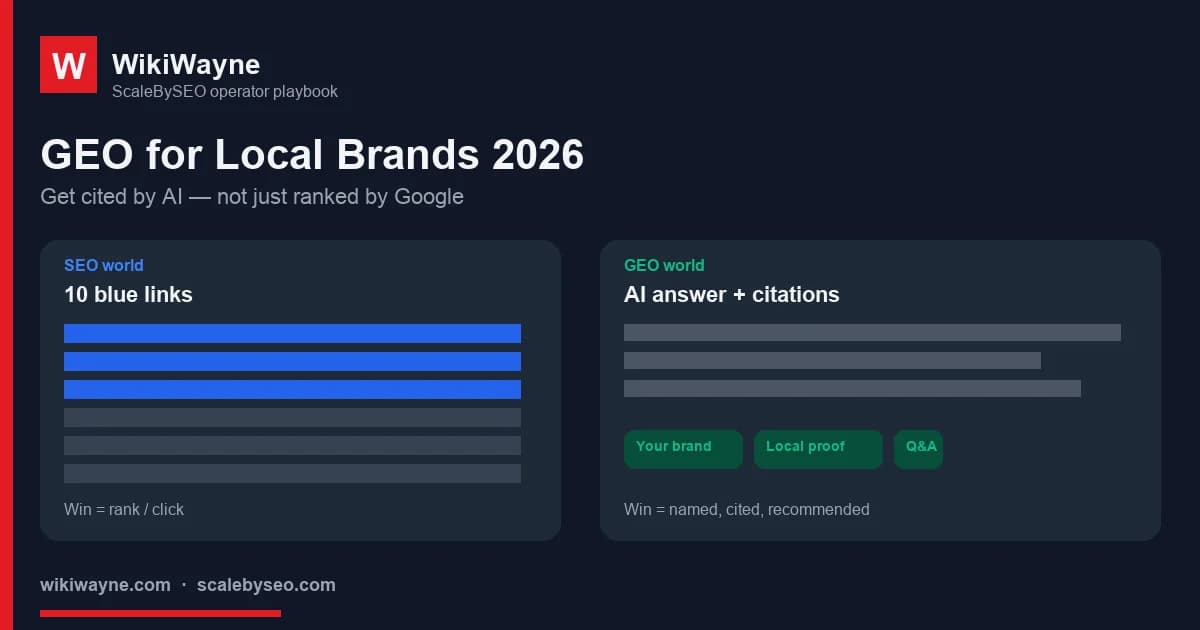
GEO for Local Brands in 2026: How to Get Cited by AI (Not Just Ranked by Google)
Classic SEO still matters. It is no longer enough. Generative engines (ChatGPT, Gemini, Perplexity, Google AI features) synthesize answers from clear passages, strong entities, and third-party proof. If your brand only has keyword pages and a thin About page, AI will recommend the competitor who wrote the better answer — even if you rank.
Key takeaways
- Classic SEO still matters. It is no longer enough. Generative engines (ChatGPT, Gemini, Perplexity, Google AI features) synthesize answers from clear passages, strong entities, and third-party proof. If your brand only has keyword pages and a thin About page, AI will recommend the competitor who wrote the better answer — even if you rank.
- GEO is making your brand easy to extract, trust, and name inside AI answers. It sits on top of crawlability, speed, and links — it does not replace them.
- The operator loop: map real prompts, write answer-first pages, make the entity boringly clear, earn independent proof, then re-probe the same 10 questions every week.

Local LLMs on NVIDIA Spark / ASUS GX10
This is a field guide for local businesses, directories, and nonprofits. It is how we think about GEO at Scale by SEO when we already run agents in production — not a list of fake “llms.txt hacks.” For the broader 2026 GEO cluster, start with the complete GEO guide and the AI-search optimization notes.
What box are we in?
Most teams are optimizing for a 10-blue-links world while their buyers ask:
“Best [service] near [city] that actually does X?” “Which organization in South Texas can help with Y?” “Is [brand] legit?”
AI systems answer those with citations and recommendations, not with your carefully crafted H1 alone.
GEO (Generative Engine Optimization) = making your brand easy to extract, trust, and name inside those answers.
It sits on top of SEO. It does not replace crawlability, speed, or links.
Google’s own guidance still boils down to people-first content and solid SEO fundamentals — not gimmick files. Treat “AEO/GEO hacks” that ignore usefulness as noise. Build passages AI can quote without lying.
GEO vs SEO (operator version)
| SEO | GEO | |
|---|---|---|
| Win condition | Rank / click | Get named, cited, recommended in AI answers |
| Unit of work | Page + keywords | Passage + entity + proof |
| Structure | Keyword sections | Answer-first then depth |
| Proof | Backlinks, GBP, reviews | Same plus Q&A platforms, earned mentions, comparisons |
| Cadence | Publish and prune | Publish, refresh, re-probe visibility |
| Failure mode | Page 2 | Competitor becomes the default answer |
If you only do SEO, you can still lose the conversation happening above the click.
The 7 moves that actually move local GEO
1. Map prompts, not just keywords
List 15–25 real questions buyers (or donors) ask in full sentences:
- “Who offers [service] in the Rio Grande Valley?”
- “Best dog park near me with water and shade in [city]?”
- “Ethical shopping alternatives to [category]?”
Group them into clusters (service, trust, comparison, local, how-to). Each cluster owns one URL. No orphan FAQs sprinkled randomly.
2. Write answer-first pages
Every money page and hub gets this shape:
- Direct answer in 40–60 words under the H1 (what AI lifts first).
- Bullets with specifics (city names, hours patterns, who it is for / not for).
- Proof block (stats you can stand behind, process, credentials — never invented impact stories).
- Local entity block (legal name, city, service area, categories).
- FAQ (real objections) with schema where appropriate.
Example open for a local service brand:
Quick answer: [Brand] is a [category] serving [cities] that specializes in [narrow wedge]. Most clients come for [outcome] within [timeframe/scope]. We are not a fit if you need [exclusion].
That paragraph is your GEO asset. Everything else supports it.
3. Make the entity boringly clear
AI cannot recommend a blur.
On-site and off-site, keep one consistent string for:
- Legal / brand name
- Primary city + region (e.g., Harlingen, TX · Rio Grande Valley)
- Category labels humans actually use
- Founder/operator name where E-E-A-T helps
Same NAP discipline as local SEO — extended to About, Organization schema, GBP, LinkedIn, directories, and Q&A profiles.
4. Build a FAQ ecosystem (minimum 10 Q&As that earn schema)
Stop treating FAQ as footer fluff.
- One FAQ hub or tight FAQs on each service page
- Questions copied from sales calls, donor emails, Google “People also ask,” and Featured-style prompts
- Short answers first; detail second
- Mark up with FAQPage where it matches visible content
AI systems are question machines. Feed them clean Q→A pairs.
5. Earn third-party proof (the unsexy moat)
GEO rewards brands that show up outside their own domain:
- Featured.com / expert Q&A — answer high-intent questions in your niche at a weekly cadence (this is why we automated it for clients).
- Reviews with specifics (service + city + outcome language).
- Local news, chamber, ministry partners, association pages.
- Comparison and “vs” content that is fair, not spammy.
If the only place your brand exists is your homepage, generative engines have nothing independent to lean on.
6. Structure for extraction (not “chunking theater”)
Practical checklist:
- Clean H2/H3 hierarchy; one idea per section
- Tables for comparisons
- Named entities in plain text (not only logos)
- Author byline + credentials on key articles
- Freshness: update stats and “as of [month year]” on living pages
- Don’t block reputable AI crawlers unless you have a real reason
- Skip cargo-cult files that don’t change how models cite you
7. Measure like an operator, not a tourist
Once a week, ask the engines the same 10 prompts:
- Does our brand appear?
- Which URL/passage would they have lifted?
- Who is named instead?
Log it. Fix the losing prompts with better answers or better proof — not with more adjectives.
If you want that probe automated later, that is a separate product surface (visibility pulse). It is not a substitute for fixing the pages. This post is the content + offer, not the tracker.
Mini case pattern: directory + local proof loop
Take a niche directory or local brand (the pattern we use conceptually for properties like BuyWokeFree or local service clients):
- Entity home — crystal-clear who/what/where.
- Cluster pages — one prompt family each, answer-first.
- Weekly Q&A — Featured.com (or equivalent) answers that reuse the same facts as the site.
- Social proof posts — only from real shipped work (no fake case studies).
- Refresh — when a prompt loses, rewrite the passage and re-answer the public Q.
Agents help with draft, schedule, and consistency. Humans own truth, especially anywhere kids, health, money, or faith trust is on the line.
Nonprofit note (because sloppy GEO is a liability)
If you serve vulnerable people:
- No child names, case detail, or “inspirational” scrapes from files.
- Evidence only. Fail closed on privacy.
- GEO for nonprofits is stewardship of reputation: clear programs, clear geography, clear ways to help — so AI doesn’t invent your mission for you.
Operator CEOs already know this. Most “AI for good” decks do not.
14-day GEO Launch Sprint (what we run)
| Day | Work |
|---|---|
| 1–2 | Prompt map (25 questions) + competitor citation spot-check |
| 3–4 | Entity cleanup (site + GBP + schema + About) |
| 5–8 | 3 answer-first pages (or rewrites) + FAQ block |
| 9–11 | Q&A engine live (Featured.com or agreed platform) — 5 answers |
| 12–13 | Internal links + proof blocks + author/E-E-A-T pass |
| 14 | 10-prompt baseline log + next 30-day backlog |
Done means: a stranger (or an AI) can state who you are, where you operate, and what you’re for — and has somewhere independent that agrees.
DIY operators can run this as a checklist. If you want it done-with-you, that is the Scale by SEO services conversation — or contact WikiWayne.
What we refuse to sell you
- “Guaranteed ChatGPT rank #1”
- Mass AI content with no operator review
- Privacy-hostile nonprofit storytelling
- Tooling cosplay with no page-level fixes
If an agency cannot show which prompts they are winning and which passages they rewrote, they are selling vibes.
Closing
SEO asks: Can Google find and rank the page? GEO asks: When someone asks the real question, does the model have a clean, trustworthy reason to say your name?
Local brands that answer the second question — with structure, proof, and cadence — will quietly take market share from bigger players still polishing keyword density.
Want the sprint run on your brand? Scale by SEO builds this with the same agentic stack we use on our own properties — humans on truth, agents on throughput. Start at services or wikiwayne.com/contact.
— Wayne Lowry · ScaleBySEO / WikiWayne · Harlingen, TX
Frequently asked questions
Generative Engine Optimization (GEO) is making your brand easy to extract, trust, and name inside answers from ChatGPT, Gemini, Perplexity, and Google AI features. The unit of work is a passage plus a clear entity plus proof — not just a keyword page.
No. GEO sits on top of SEO. You still need crawlability, speed, and links. If you only do classic SEO, you can rank and still lose the conversation happening above the click.
Write answer-first pages (40–60 word direct answer under the H1), keep one consistent name/city/category string on-site and off-site, mark up real FAQs, and earn third-party proof (reviews with specifics, Q&A platforms, local mentions). Then probe the same buyer questions weekly and fix losing passages.
A two-week operator sequence: prompt map, entity cleanup, three answer-first pages plus FAQ, a live Q&A engine, internal links and E-E-A-T, then a 10-prompt baseline log. Done means a stranger — or an AI — can state who you are, where you operate, and what you are for.
Fail closed on privacy. No case detail, no child names, no invented impact stories. GEO for nonprofits is stewardship of reputation: clear programs, clear geography, clear ways to help — so AI does not invent your mission for you.
Affiliate Disclosure: As an Amazon Associate I earn from qualifying purchases. This site contains affiliate links.